536 stories
·
0 followers

How to Tax Billionaires

1 Share

If you made money last year, you will almost certainly owe taxes by April 15. And if you made a lot, you will probably owe a lot. That’s true for most Americans—just not the richest ones.

And if that makes you angry, you’re justified in feeling that way. But the solution you’re hearing from a lot of politicians at the state and federal levels—wealth taxes—isn’t the answer. Instead of introducing a new, difficult-to-administer, and potentially unconstitutional tax, we should do something simpler: Bring billionaires back into the income-tax system. Believe it or not, the way to do this starts with abolishing the estate tax.

You probably think that sounds nuts. But the estate tax hardly raises any money—less than 0.5 percent of federal revenue—and yet at the same time makes it seem like the rich pay more in taxes than they do. Our current jumble of tax rules, with separate taxes for income and estates, stokes confusion and misunderstanding.

The tax system that we currently have—a progressive income tax with an additional estate tax—was enacted after the Gilded Age and was specifically designed to impose the greatest taxes on the rich. Over many decades, the richest Americans have cultivated a three-step tax-avoidance playbook.

The first step: Don’t take a big salary. The greatest tax burden is imposed on those who get paid for work. A Californian earning a $10 million salary would owe more than $5 million in combined federal and state taxes. And payroll taxes are imposed on even the lowest earners. A self-employed California Uber driver earning $60,000 would still owe almost $15,000 in taxes.

[Rogé Karma: Buy, borrow, die]

That is why Warren Buffett’s combined salary and bonus was capped at $100,000 for decades. Jeff Bezos’s was set at $82,000 a year, low enough to make him eligible to claim the child tax credit (which he did!). Many others, including Mark Zuckerberg and Larry Ellison, are $1-a-year men. They are all low-salaried and still well compensated. The great bulk of their pay comes from the growing value of their stock. The magnitude of this growth is staggering. Since 2023, Buffett’s wealth has increased by $35 billion, Bezos’s by more than $100 billion, Zuckerberg’s by more than $150 billion, and Elon Musk’s by $500 billion.

By forgoing a salary and instead relying on the value of their shares, these individuals shift their tax bill from the income- and payroll-tax rules applicable to wage earners to the capital-gains rules applicable to investors. Their tax rates are lower: The maximum rate for long-term gains is 23.8 percent, once you factor in a surcharge for high earners known as the net-investment-income tax. But the greatest benefit accrues to those who avoid stock sales, and thereby taxes, altogether. This is the second step of the tax-avoidance playbook.

Deferring taxes on profits until a property is sold is the greatest tax advantage in our system. In the United States, this lets investors and their heirs (and their heirs) avoid taxes indefinitely. By using stock and other properties as collateral for loans, the very wealthy can enjoy the financial benefits of their wealth without the burden of taxes. Many of the richest Americans—including Ellison and Musk—support their lifestyle this way.

An obscure Securities and Exchange Commission rule change in 1982 dramatically increased this opportunity for tax avoidance. Before then, the only way that an American company could share profits with its stockholders was by issuing dividends. For much of the 20th century (though not anymore), dividends were subject to high tax rates, similar to the ones imposed on salaries. People who owned lots of stock typically received lots of dividends and therefore paid lots of income tax.

Beginning in November 1982, the SEC ruled that companies using their profits to buy back their own stock would be given safe harbor from price-manipulation investigations. Buybacks reduce the number of outstanding shares, which tends to boost a stock’s price. The effect of this was to make taxes on these profits optional, because shareholders who did not sell could enjoy tax-free growth indefinitely.

The third step used by rich Americans to avoid income taxes is by acquiring money the old-fashioned way: through inheritance. Someone who inherits $10 million—or even $100 million, or $100 billion—doesn’t even have to report it on their income-tax return. The exclusion from income tax for gifts, life insurance, and inheritances is based on the assumption that a well-functioning estate tax is addressing these assets. This is no longer the case.

In part because of a powerful lobbying campaign funded by 18 of the country’s richest families, much of the public has come to see the estate tax as an immoral “death tax.” Congress has not moved to close any of the loopholes that wealthy Americans and their tax planners have developed to avoid or minimize payment of the estate tax since 1990. As a result, the tax has become functionally eliminated, even though it still appears on the books.

Instead of introducing a wealth tax or trying to reimpose the estate tax to capture the more than $50 trillion in stocks, real estate, art, and other assets owned by the richest 1 percent of Americans, tax reformers should agree to abolish the estate tax. Its reputation has been too tarnished for it to be restored. Calling “uncle” on the estate tax for good would create an opportunity to introduce a simpler and more coherent system that would tax inheritances as well as investment gains using income tax, instead of through a separate system.

To ensure that the person who earns investment gains pays the tax bill, taxes should be paid on gains whenever property is transferred—not just by sale, but by gift or at death as well. A rule like this has worked in Canada for decades. It will work here too.

Without an estate tax, the government can bring gifts, inheritances, and life insurance into the income-tax system, where they rightly belong. Unlike the estate tax, an inheritance tax would not be assessed on the assets of a dead person. It would instead tax the person who receives the money, just as we tax nearly all other acquisitions of wealth.

[Annie Lowrey: How the richest people in America avoid paying taxes]

The income-tax system is designed to be a broad-based system imposed on—in the words of the tax code—“all income from whatever source derived.” This is why lottery winnings, money found on the street, and even barter exchanges are subject to income tax.

This does not mean that every dollar received as a gift or an inheritance needs to be taxed. The system could provide exclusions for education, transfers to spouses, health care, and annual gifts, perhaps using the current $19,000-a-year exclusion for gift taxes. We could make special accommodations for family farms and businesses. In addition, each person could be allowed to inherit $1 million, even $2 million, tax-free. Heirs receiving more than the tax-free limit would pay ordinary income-tax rates, just as lottery winners do. Life insurance, too, would be taxed to the person who receives them.

This expansion of the income tax would raise money not just for the federal government, but also for the majority of states, which use the federal definition of taxable income as a starting point for their own income-tax rules.

These reforms would create a simpler, fairer tax system, wherein the wealthy pay taxes based on the profits they earn and the income they acquire, not the complicated web of loopholes they currently navigate.

Read the whole story
Condiment9294
14 hours ago
reply
Seattle, WA
Share this story
Delete

A Fine Country for Old Men

1 Share

Gerontocracy has always thrived in undemocratic places—Communist people’s republics, Gulf monarchies—where only death could pry power from the ruling elders. American gerontocracy is exceptional for being freely elected. Donald Trump will soon be an octogenarian, and is president in part because the preceding octogenarian, Joe Biden, did not want to admit his senescence. The median senator is 65, and the oldest, 92-year-old Chuck Grassley, has not ruled out running for reelection in 2028. The typical general-election voter is a spry 52, but in primary elections, which decide the majority of political contests, that number rises to 59. Half of all the money donated to political campaigns comes from Americans age 66 and older.

Although political gerontocracy has operated overtly, the rising economic power of the elderly has escaped much notice. Over the past 40 or so years, American wealth has grown ever more concentrated among the oldest generations. In 1989, Americans over age 55 held 56 percent of it; today they hold 74 percent. During that same period, the share of wealth held by Americans under 40 has shrunk by nearly half, from 12 to 6.6 percent. The color of money is now gray.

Much of this shift is the result of demographic change: 18 percent of Americans are senior citizens today, up from 13 percent in 1990. But even at the household level, Americans over 55 have accrued wealth more rapidly than those who are younger. Among those 75 and older, the numbers are particularly striking. In 1983, their household net worth was only slightly above the national average; by 2022, it was 55 percent higher.

For nearly a century, some of the central debates in American politics have been over inequalities—between rich and poor, male and female, Black and white. When the Baby Boomers were children, older Americans were widely viewed as vulnerable. “Fifty percent of the elderly exist below minimum standards of decency, and this is a figure much higher than that for any other age group,” Michael Harrington wrote in his 1962 book The Other America, often credited with inspiring the War on Poverty. “This is no country for old men.”

Three years later, in 1965, Medicare was created. A major expansion of Social Security followed in 1972. These changes were remarkably effective: The share of elderly people living in poverty dropped by more than one-third within a decade. But because these programs are broad-based entitlements, they have transferred huge sums to the prosperous, too. The portfolios of that latter group, meanwhile, have been swelled by a rising stock market and rising home values, outcomes that may not be entirely replicable for younger generations. As a result of all of these factors, intergenerational inequality between old and young has not merely reversed. It has accelerated.

Most current Social Security and Medicare beneficiaries will receive more from the program over their lifetime than they paid in taxes, and the extra money will necessarily come from the pockets of younger generations. The two programs now pay out more than $2 trillion a year, more than one-third of all federal expenditures. Their sustainability was a subject of major debate during the Obama years, when the national debt was much lower than it is today and interest rates on that debt were close to zero. Financially, the matter is more urgent now. The trust funds for Social Security benefits and Medicare’s hospital insurance are projected to become insolvent in roughly seven years.

[Lyman Stone: The Boomers ruined everything]

Yet even noticing the looming threats has become taboo for the two major political parties. One of Trump’s shrewdest political realizations was that entitlement reform—once a priority for fiscal conservatives—was a losing issue. Instead, he has pledged not to touch entitlement spending and lavished seniors with even more government money. His One Big Beautiful Bill Act created a special $6,000 tax deduction for seniors, which will cost taxpayers $91 billion over the next four years. The same bill cuts $1 trillion in spending on Medicaid, which is expected to leave some 5 million working-age Americans uninsured.

This bodes poorly for intergenerational peace. Respect for elders is being replaced by resentment of elders. A majority of young Americans no longer believe in the American dream. Many Millennials and Gen Zers expressly blame the Boomers for that, accusing them of hoarding wealth, jobs, and power. Many of these accusations are inchoate, but they are not entirely baseless.

The best rebuttal to the gerontocratic critique is that young Americans do not appreciate how good they have it. Although people of working age possess a smaller share of the national wealth, they are richer in absolute terms than Boomers were at their age. The median 35-year-old Millennial earns 38 percent more in post-tax, inflation-adjusted income than the typical Boomer did at the same age, according to research by the economist Kevin Corinth. Gen Zers have only begun their careers, but so far they are earning more than their Millennial predecessors. This trend shows up in wealth statistics, too. When Boomers were between the ages of 25 and 43, they had a median net worth of $58,000 (in 2022 dollars); Millennials at the same stage of life had a net worth of $85,000. So why are young Americans so depressed about their economic future?

[From the May 2023 issue: Jean M. Twenge on the myth of the broke Millennial]

The pathologies of the housing market are one reason. The typical home today costs five times the median annual income, up from 3.5 times the median annual income in 1984. Boomers got lucky: When they were young, they could afford to buy houses that then appreciated fantastically in value. But that luck was arguably manufactured by Washington, which engineered the rise of 30-year, fixed-rate mortgages and created tax deductions for mortgage interest and property taxes.

These government subsidies still exist today. But even with them, younger Americans cannot buy houses at the same rate that Boomers did. In a paper titled “Giving Up,” the economists Seung Hyeong Lee and Younggeun Yoo predicted that Millennials will enter retirement with much lower homeownership rates than the generations before them—74 percent compared with 84 percent for Boomers. Some 15 percent of Millennials, they noted, had already given up on homeownership by age 30. These Millennials, they found, work less, spend more on credit, and are more likely to buy cryptocurrency or make other risky investments. Feeling locked out of owning a house casts a malaise—one made worse by the anxiety that the welfare state they currently support will become stingier when they eventually need it.

Older generations used the levers of government to create this situation. In high-cost cities, the building of new homes and apartment complexes is often derailed in local planning and zoning-board meetings. In 2019, the political scientists Katherine Levine Einstein, Maxwell Palmer, and David Glick published a study examining who attended such meetings in the Boston area. The attendees, they found, were likely to be longtime homeowners who oppose new development. Preventing construction kept the value of their assets high—at the expense of younger, prospective homeowners.

Homeowner preferences hard-coded into state constitutions decades ago now further sustain the gerontocracy. In 1978, Californians voted by referendum for Proposition 13, which severely limited the property taxes that existing homeowners would have to pay—so long as they remained in place. In one study, the law was estimated to have caused a 15 percent increase in California housing prices all by itself. As longtime homeowners profited, the lost tax revenue forced reductions in school spending.

California is not unique, and housing is not the only means by which the older generations have effectively pulled up the ladder behind them. Preferences for the elderly over the young are a fixture of public budgets nationwide. Across all government programs—federal, state, and local—$2 are now spent on seniors for every $1 spent on children.

According to Tim Vlandas, an Oxford political economist, advanced democracies around the world are reaching the point of “gerontonomia”—his term for a stagnating political economy set up to prioritize elderly citizens. These citizens punish their elected governments for inflation, which lessens the value of savings and pension payments. They are much more tolerant of unemployment, because they no longer work; slow growth, because their wealth has already accumulated; and high public debt, because their descendants will pay it. The result, Vlandas argues, is lower wage growth for those still working, and also worse outcomes for their children, as a result of lower social investment over the course of their lives.

Graying democracies everywhere have made generous pension commitments that they are struggling to maintain. In the United Kingdom, the “triple lock,” a rule that in most years mandates that state pension payments increase more than inflation, seems politically impossible to change. In France, people protested for months against Emmanuel Macron in 2023 over the raising of the retirement age from 62 to 64.

Yet these challenges are especially acute in America. Because Social Security still has a trust fund to draw on, voters may not realize that benefits already exceed contributions. But this fund, which stood at $2.9 trillion in 2021, is on pace to dwindle to zero by about 2033. The Trump administration’s immigration crackdown will hasten the arrival of exhaustion day by cutting the number of tax-paying workers who support retirees’ benefits. Once that trust fund is gone—absent a tax increase on current workers or some other change—beneficiaries would suffer an immediate 23 percent cut in payments. A similar process would leave the Medicare Part A program, which covers hospital stays for the elderly, insolvent at about the same time.

The national debt will by then be gargantuan. Previously unthinkable ideas—such as means-tested Social Security benefits, confiscatory wealth taxes, even health-care rationing—might be contemplated. The bill coming due for the senior welfare state might not trouble this president, but it could well be the defining problem for the next one.

Some people would like to start the fight over how to resolve it now. Among them are radical thinkers who contend that in order to defeat economic gerontocracy, Americans must first defang the elderly ruling class. In his forthcoming book, Gerontocracy in America, the 54-year-old Yale law and history professor Samuel Moyn calls for destroying this “tyranny of the minority,” set up by “old people with enormous private power who hold society in chains.” Power, he argues, needs to be seized back, leaving “the elderly divested of political power, wealth, and property.”

Moyn wants to create mandatory retirement ages, perhaps starting as low as 65, for elected officials and people with some desirable private-sector jobs. Then he would come for the money, increasing taxes on both income and accumulated assets to dilute the share of elderly wealth. Most astonishingly, he proposes diluting older Americans’ political power too, by literally valuing the votes of young people more, on the theory that the latter will suffer the consequences of political decisions for much longer. (This proposed social engineering is both harsh and vanishingly improbable. The modern legal principle of “one person, one vote” exists for good reason.)

Still, Moyn’s ideas underscore the need for an equitable post-Boomer settlement, one that will be easier to find if we start the search sooner rather than later. In the 20th century, the United States realized it was too rich and too decent a country to allow its elderly citizens to live in penury. And it made an enduring commitment to address that problem, one that has unequivocally succeeded: There has never been a better time to be a senior citizen in America. And yet the U.S. has made no comparable commitment to working families, who are stymied not only by expensive housing but also by child-care and higher-education bills. Child poverty in America persists at levels alarmingly higher than in other advanced democracies.

Initiatives such as Franklin D. Roosevelt’s New Deal and Lyndon B. Johnson’s Great Society established what current workers in a decent country owed to retirees. A new social contract can be struck that would deliver at least some optimism for today’s workers. Curing gerontonomia would require redirecting some public funds from programs aimed at the elderly, such as Social Security, to family benefits, education, and infrastructure. But an intergenerational recalibration can come about in gentler ways than Moyn’s: The wealthiest Social Security recipients, for instance, could forgo some of their scheduled benefits, which could instead be contributed annually to “baby bond” accounts for America’s children, a source of capital to be used in adulthood.

And not every solution rests with the welfare state. Cutting through housing restrictions would generate enormous social benefit, if America’s elderly ruling class were to allow such a feat. Today’s gerontocrats will eventually die. But their legacy will be a mess to sort out.


This article appears in the May 2026 print edition with the headline “A Fine Country for Old Men.”

Read the whole story
Condiment9294
14 hours ago
reply
Seattle, WA
Share this story
Delete

Ignorance and Ignominy

1 Share

A sign on a street

AI-generated content may be incorrect.

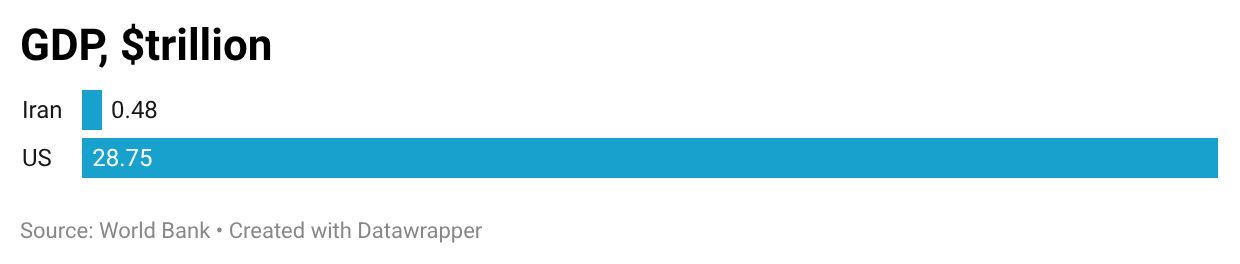
So the world’s greatest military power went to war with a poor, medievalist theocracy. It was an incredibly uneven match. Here’s are the GDPs of Iran and the United States in 2024:

A blue line on a white background

AI-generated content may be incorrect.

Yet Iran won. The Iranian regime has emerged far stronger than it was before, controlling the Strait of Hormuz and having demonstrated its ability to inflict damage on both its neighbors and the world economy. The U.S. has emerged far weaker, having demonstrated the limitations of its military technology, its strategic ineptitude and, when push comes to shove, its cowardice.

We’ve also destroyed our moral credibility: Trump may have TACOed at the last minute, but he threatened to commit gigantic war crimes — and for all practical purposes our political and civil institutions gave him permission to do so.

How did this happen? Naturally, the Iranian Minister of War credited divine intervention, declaring that “God deserves all the glory.” His nation, he said, fought with the “protection of divine providence. A massive effort with miraculous protection.”

Well, theocrats gonna theocrat.

But I lied. That wasn’t a quote from an Iranian official. That’s what Pete Hegseth, our self-proclaimed Secretary of War, said while claiming that one of the worst strategic defeats in American history was a great victory.

There will be many analyses by military and strategic experts of the Iran debacle. But let’s not lose sight of the larger picture: We were led to disaster by the boastful ignorance of men like Trump and Hegseth — boastful ignorance made even worse by claims that God supports whatever they want to do.

With men like that running America, major disasters were just a matter of time. I’d like to think that they have been chastened by this debacle, that they have learned something. But I don’t believe that for a minute.

God help us.

MUSICAL CODA

Read the whole story
Condiment9294
5 days ago
reply
Seattle, WA
Share this story
Delete

The Anti-Intellectualism of Silicon Valley Elites

1 Share

I recently re-read Richard Hofstadter's Anti-Intellectualism in American Life, and now every time a reactionary Silicon Valley billionaire opens his mouth, I think about it. So I wrote about it for The Nation. Here's the column:

On Instagram, there’s an activist named Brian Patrick (@pano.dime) who has dedicated his account to “posting an insane thing an AI executive said every day in 2026.” I can’t stop thinking about his entry for Day 15, quoting the CEO of a company called Suno, Mikey Shulman, as he claimed that musicians hate the process of making music. “It’s not really enjoyable to make music now,” he said. “It takes a lot of time, a lot of practice, you need to get really good at an instrument or really good at a piece of production software. I think a majority of people don’t enjoy the majority of the time they spend making music.”

This would be news to every professional musician I know, and I live in a part of Brooklyn that’s adjacent to a neighborhood I think of as Dad Band Land because it’s populated by a disproportionate number of aging indie rockers with kids. But it’s not the ludicrousness of Shulman’s statement that sticks with me; it’s the swaggering know-nothing elan behind it, which is symptomatic of Silicon Valley’s deep-seated anti-intellectualism.

As the historian Richard Hofstadter noted, a fierce anti-intellectual spirit has long animated American culture, but it has typically targeted the knowledge elite from below. What’s striking about today’s brand of anti-intellectualism is that it infuses the American knowledge elite; it stems from the bedrock conviction among tech oligarchs that they have mastered everything and have nothing left to learn. In this cloistered vision of tech-driven learning, they believe that deep intellectual work—the kind you do when you author a complex piece of music, for example—has little or no inherent value. Their disdain for it has fueled their attacks on higher education, the humanities, and learning for its own sake, which they believe has no purpose beyond its inevitable digitization and monetization.

The examples are everywhere: Peter Thiel’s crusade against college attendance and his program that subsidizes high school students who want to forgo it, Marc Andreessen’s boasts that he actively avoids introspection, the gleeful prediction of Thiel’s Palantir colleague Alex Karp that AI will hurt educated women the most. That all of these scourges of learning for learning’s sake are themselves beneficiaries of privileged educations doesn’t matter: As ardent monopolists, they’ve managed to believe they’ve cornered the market on critical thinking. Everyone else needn’t be troubled by the rigors of learning, since they exist solely to serve as drones in the tech regimes of the future.

The irony of this posture is that there’s almost no sector of American life—with the notable exception of the tech world’s political retainers in the Trump White House—that is less welcoming to rigorous thinking than Silicon Valley. The apostles of algorithmic dominance cheerlead chatbots and technocratic shortcuts for thinking and reasoning, and use them extensively themselves, even though the models hallucinate and have a baleful tendency toward sycophancy. “Researchers found that nearly a dozen leading models were highly sycophantic,” a recent New York Times story on the explosion in AI chatbots reported, “taking the users’ side in interpersonal conflicts 49 percent more often than humans did—even when the user described situations in which they broke the law, hurt someone or lied.” The obsequious intellectual concierges of the AI revolution also reduce cognitive strain on users, which further weakens their capacity for thinking. An MIT Media Lab study titled “Your Brain on ChatGPT” found that LLM users “consistently underperformed at neural, linguistic, and behavioral levels.” The tech oligarchs have somehow managed to enshittify thinking.

This shouldn’t come as any great surprise to students of the dismally incurious and claustral mindscape of Silicon Valley. Tech oligarchs have erected a new cognitive technology designed to fry users’ brains after they’ve effectively lobotomized themselves with a real-world version of the same process. Our tech lords have long made a practice of outsourcing their thinking to the many people (and technologies) devoted to digesting difficult material and summarizing it for them. In their working lives, they then proceed to surround themselves with yes men and peers who affirm everything they say; the beta version of the cringy displays of great-leader sycophancy that break out in every Trump cabinet meeting was perfected in the boardrooms of Silicon Valley.

This lovingly tended bubble of privilege makes it easy for tech oligarchs to avoid any of the discomfort that comes with questioning their modes of existence or confronting even minor levels of adversity. A tweet from a few years ago neatly summarized the mental costs of this lifestyle: “Being a billionaire must be insane. You can buy new teeth, new skin. All your chairs cost 20,000 dollars and weigh 2,000 pounds. Your life is just a series of your own preferences. In terms of cognitive impairment, it’s probably like being kicked in the head by a horse every day.”

The tech lords’ ethos of intellectual secession is also rooted in two key maladies of American society: a general disdain for the intellectual class; and the overclass’s wariness toward—and not infrequent open hostility to—upward class mobility, which still largely rests on access to higher education.

Hofstadler’s 1964 Pulitzer Prize–winning book Anti-Intellectualism in American Life has aged in certain ways, but it brilliantly traces the dogmas of anti-intellectualism to our founding mythologies—most especially, to the veneration of the self-made man by the business class. The self-made man was always a self-serving fable meant to conceal the deep fissures of rule by a business aristocracy. Now that much of America’s wealth is inherited or the product of luck and equity appreciation that is wildly disproportionate to the material contributions of any founder or CEO, our billionaire entrepreneurs and business owners are even less self-made than they used to be.

Still, the myth persists, and you can see it in the tech oligarchy’s insistence that they owe the rest of society nothing as a consequence of their own Promethean genius. That’s the logic behind Silicon Valley’s vision of complete oligarch defection from the grubby dictates of social existence in common with fallen humanity and the dawn of a utopian “networked state” created by and for the tech elite. Less grandiosely, it’s also the tech oligarchs’ rationale for not paying their fair share of taxes, and their attempts to extract resources from the public sector via school vouchers, privatization, and regulatory capture.

On some level, our tech lords are aware that their wealth is built on the backs of others, and like other moguls who’ve built fortunes by extracting wealth from the commons, they fear what would happen if workers manage to transcend their preordained social class or otherwise become more difficult to control because they’ve used their brains to organize against their owners and managers.

You can trace the modern history of this fear in the tension between purely academic disciplines and vocational education, which arrived on the American scene alongside the advent of the modern business school. Business education canonized the training of aspiring managers to commandeer the redoubts of industrial-age capitalism and paid little more than lip service to intellectual development.

Even under this charter solemnizing an aggressively instrumentalized pursuit of knowledge, early business schools were wary of any instruction that might cause workers to evaluate the competency of the managerial class. As Hofstadter writes: “When Dean Wallace Donham of the Harvard Graduate School of Business suggested to one such school in the Middle West that it offer a course on the problems of trade unionism, he was told: We don’t want our students to pay attention to anything that might raise questions about management or business policy in their minds.”

The same self-inflicted myopia courses through the bold pronouncements of the tech oligarchs as they forecast a frictionless social order operating on the diffusion of knowledge designed to promote their own class interests. After all, much of Silicon Valley’s wealth is built on the intellectual work of others, often produced in universities and funded by the government. The STEM disciplines they hail as the vanguard of social progress are rooted not just in the sciences but the humanities as well. Yet since the unfettered quest for knowledge is anathema to them, they never acknowledge this particular intellectual debt. Instead, they hire linguists to improve the large language models of their burgeoning AI empires while disparaging the kind of people who become linguists.

They also enjoy a bit of JD Vance–style working-class LARPing on the side. Again following the faux-populist lead of the MAGA movement, tech oligarchs will wax Whitmanian on the virtues of America’s forgotten workers without of course ever sending their own children to welding school or encouraging them to become HVAC technicians. And as a matter of course, the oligarchs of Silicon Valley, who have presided over one of the most unyielding labor cartels in American enterprise, all viciously oppose unionization for tradespeople.

As the daughter of an IBEW local lineman who was still climbing power poles well into his 60s and doing contracting work on the side, I recognize a telltale attitude of patronizing condescension here—particularly when these venture capitalists mouth the words “respectable work.” It is respectable work, but it’s also work that is physically exhausting and destructive at a certain age, and has a ceiling for maximum income. Absent union organization, work in these trades offers little security or protection in a country with a weak social safety net—one that the same oligarchs would happily destroy altogether. But these oligarchs need workers more than workers need them, and they know it, despite Andreessen’s recent statement that “without us [tech oligarchs] there’s nothing but stagnation.”

This emphasis on trades and their value to working class men in particular is also of a piece with another Vance-ian strain within the tech set: the oligarchs’ reactionary insistence that gender hierarchies are simply a function of meritocracy and not patriarchy. Now that women are getting more master’s degrees than men, it has to follow that graduate education is useless.

A clear corollary of this reactionary gender ideology is the tech bros’ widespread obsession with physical strength—they view it, childishly, as a power that women cannot replicate or exceed, and treat it as a vector for measuring themselves against other men. This is not new either. In summarizing the 19th-century view toward the life of the mind, Hofstadter writes that “it was assumed that schooling existed not to cultivate certain distinctive qualities of mind but to make personal advancement possible. For this purpose, an immediate engagement with the practical tasks of life was held to be more usefully educative, whereas intellectual and cultural pursuits were called unworldly, unmasculine, and impractical.”

The tech bros’ cult of advancement serves to do much more than safeguarding the moat they’ve erected around membership in their own class. Knowledge directed toward goals other than self-advancement is a threat, for the simple reason that an informed populace is a civically active populace. You can’t preach automatic deference before a caste of tech savants to a group of workers schooled in understanding their own role as agents of social progress.

This is the other irony of the disingenuous posturing of Silicon Valley’s knowledge elite. The same people who like to tout their own high IQs, bemoan the lack of critical thinking in society, and complain that everyone else is too emotional betray an astounding failure to confront their own cognitive makeup. What separates humans from animals is our ability to contemplate our own existence and transfer complex knowledge down through generations. This species-perpetuating endeavor is rooted in complex neurological processes that involve the kind of intellectual capacities that these guys hold in dogmatic and ill-informed contempt.

Emotion, after all, is an evolutionary adaptation that feeds into pro-social behavior, not a just silly dispensable quality women have. (It’s also on lavish display among the self-styled logic-only apostles of the tech brotherhood, as any cursory consultation of their grievance-addled social-media accounts will readily confirm.) But in its preferred modes of public discourse, the tech elite rallies behind the clueless bromides of their chief (and literal) egghead, Marc Andreessen, who openly brags that he actively avoids utilizing any of these various forms of meta cognition to contemplate anything at all. This presumably empties his brain of all troubling reflections beyond the central organizing theme of the greatness of Marc Andreessen, and whatever constitutes the future of Marc Andreessen’s legacy and bank accounts.

We need intellectualism because we need liberal democracy. And that is precisely why these guys—they’re all guys—don’t like it. The poster boy for Valley-bred anti-intellectualism is the self-styled neoreactionary blogger Curtis Yarvin, an Andreessen, Vance, and Thiel favorite. Yarvin openly embraces racist psuedo-science and promotes a tech baron’s vision of autocratic rule that in his telling would transform California into a kind of feudal monarchy where a CEO-slash-king runs everything as a benevolent authoritarian. Inasmuch as tech oligarchs have a favored thinker to outsource their thinking to, he’s it. Here’s how Yarvin would evaluate his model head of state: “We can define responsibility in financial terms. If we think of California as a profitable corporation, a capital asset whose purpose is to maximize the production of cash, we have a definition of responsibility which is not only precise and unambiguous, but indeed quantitative.” In this view, the raison d’être of the state and its government should be profit making, and a tech CEO should control all of it. The pesky Volk are granted roles only as grateful vassals of their overlords; otherwise, any effort on their part to understand their own lives as meaningful would upend Yarvin’s kingly reveries. Dictatorship, but make it business.

It’s not too hard to understand why Andreessen and his cronies think the guy who says a tech CEO should be the dictator of California is a genius. But it is darkly funny that, at the individual level, they all assume the authoritarian in this scenario would obviously be someone like themselves—not another wealth hoarder who might find their existence and their monopolist empires a threat. A single political theory or philosophy class at the intro level would force them to spend five minutes thinking about the pros and cons of this scenario and its historical precedents. But you can’t possibly expect the harried lords of Silicon Valley to spend time reading very long books and examining complex nuances and contradictions when there are podcasts to go on and memes to tweet. Time is money, after all.

In Yarvin’s view, the sinister forces of democracy are represented in a numbing bloc of consensus he calls “the Cathedral”—educational institutions, journalists, culture makers. This presumably includes me, a middle-class writer living in Brooklyn who believes in liberal democracy and sends her kid to public school. Yarvin would argue I am brainwashing you into rejecting things like his “chief executive dictator” idea, which cannot be dismissed on its own merits, but only via conspiracy.

Ultimately, this is the core of it: The anti-intellectual Yarvinites of the tech world value order over change—specifically, an order where they are in control and do not have to worry about nettlesome things like changing demographics, competition, or being wrong about anything at all. They pay lip service to innovation but hate the deep mental work and creativity that produces novelty and original thought. They care about such things only if they can be turned into a $20-a-month subscription service and then parlayed into mission-critical enterprise software.

This model of mental rentiership will make them still more galactically rich, which will continue to underwrite their endless regress of Techcrunch summits and TED talks where they can do the only tangible work they care about: one-upping each other like kindergarteners on a playground bragging about who has the best toys. They do not want to think, and when they exchange ideas, they recycle the same ones that have already won inert allegiance among their fellow members of the overclass. If they were somehow to stumble into an unfamiliar (and therefore original) thought formation, it would in all likelihood succumb to the degraded rounds of elite gossip that they’ve managed to elevate into the omniscient discourse of self-congratulatory moguldom.

This is, to put it mildly, a terrible state of affairs because these people have far too much power and they countenance far too few constraints on what they can do with it. They value their own expertise, but reflexively deride that of others—especially anyone who has the temerity to demand a voice in public life and a say in how our society is constructed without wealth as the arbiter of every social good. But for now, at least, they keep showing their hand—a useful weakness to exploit for those who wish to outsmart them.

As always, thank you for reading! Here are some ways to support my work, if you're inclined.

And here is a random thing that feels kind of old school Internet, for your enjoyment.

Elizabeth

Read the whole story
Condiment9294
8 days ago
reply
Seattle, WA
Share this story
Delete

March, 19-21: God is a comedian

1 Share

It is a well-established fact that the universe has a sense of humour. It is less well-established, but increasingly obvious, that the humour is of the kind best enjoyed from a great distance, like, let’s say the moon.

Three weeks into the Iran war, reality has passed through the looking glass, out the other side, and is now selling tickets to the gift shop. What follows is not satire. Satire requires exaggeration, and you cannot exaggerate something that is already operating at maximum absurdity. This is simply the news, and nothing but the news. Told straight, in a universe that has clearly stopped taking its medication.

The United States is sending 5,000 Marines into the Persian Gulf to seize Kharg Island, a speck of land 15 miles off the Iranian coast that handles 90% of Iran’s oil exports. This is, on paper, a reasonable military objective in the same way that sticking your hand into a beehive is a reasonable way to acquire honey. It is technically correct. The bees would disagree.

Image

To reach Kharg Island, the Marines aboard the USS Tripoli and USS Boxer must first sail through the Strait of Hormuz, which Iran has mined. The strait is also, as of this week, a toll road. The IRGC verifies vessels on VHF radio and charges up to $2 million per transit, payable in cash, cryptocurrency, or barter. At least eight ships have paid. Iran’s parliament is legislating the arrangement formally, because even revolutionary theocracies require a compliance department.

A White House source told Axios they need “about a month to weaken the Iranians more” before attempting this. One month. Of a war Trump described as ‘winding down’ on Friday - three weeks in, which by his count is basically four days… Both statements were made, as far as anyone can tell, by people who occupy the same government and occasionally share a building.

A former Navy SEAL called the plan “insane”. A retired Vice Admiral called it “a massacre-in-making scenario”. A retired Rear Admiral pointed out that even if they seize the island, Iran simply turns off the pipeline at the other end. Frankly, I think they're being extremely polite. This is a clusterfuck of historic proportions and everyone who's ever held a rank knows it.

Image

The USS Gerald R. Ford, meanwhile, the most expensive warship in human history, is retreating to Crete. The official reason is a “laundry fire”. 266 consecutive days at sea, 28 days short of the Vietnam-era deployment record, and the crown jewel of the US Navy is fleeing the theatre, not because of being damaged in combat, not because missiles are flying around it… But because someone's skivvies got too hot.

Image

France, in a display of allied solidarity, deployed the aircraft carrier Charles de Gaulle to the region. Its precise location was then revealed to the entire internet by a sailor who went jogging on deck with Strava running. Iran’s calling B7.

There exists in diplomacy a concept known as “sanctions”, which works on the same principle as telling a child they can’t have dessert while you’re eating cake in front of them. The United States has been sanctioning Iran for years. It has also been bombing Iran for three weeks. These are, in the normal course of events, complementary activities. One is economic warfare. The other is the regular kind.

This week, the US Treasury lifted all oil sanctions on Iran. For 30 days. 140 million barrels of Iranian crude, sitting on ships at sea, may now be sold freely on the global market. Including to the United States itself.

In yuan.

The United States is purchasing, with Chinese currency, oil from the country it is currently bombing?! The same oil that funds the missiles that just shot down an F-35 for the first time. The same missiles that are redecorating allied oil infrastructure.

Treasury Secretary Bessent called this “narrowly tailored”. Narrow like in white, and tailored as in card, apparently.

In the same OFAC filing, Russian oil sanctions were lifted as well. And Belarus potash too, because apparently the universe was running low on irony and needed to top up.

The logic, insofar as there is any, goes like this: the war has crashed the global oil market so hard that the administration needs the enemy’s oil to keep gasoline prices from eating the midterms. They are unsanctioning the people they’re bombing because the bombing is working too well at the thing they didn’t want it to do. The sanctions were necessary to stop Iran funding the war, but the war made the sanctions too effective, so the sanctions had to be lifted to fund the war effort against the country that no longer needs sanctions because the oil revenues that sanctions were preventing are now required to prevent the economic damage caused by preventing those revenues, which is itself a consequence of the military campaign designed to make the sanctions unnecessary by making Iran the kind of country that doesn’t need sanctioning, which it would be, if the sanctions hadn’t been lifted to pay for making it that.

Two F-35 stealth fighters have been hit by Iranian air defences. The first was confirmed by CENTCOM, which used the phrase “emergency landing” in the way that a funeral director might describe death as “a permanent change of address”. The pilot had shrapnel wounds. The aircraft, they said, “will not return to service”, which is the sort of thing you say about a car that hit a bridge abutment at speed, not about a plane that landed.

A Chinook helicopter was subsequently tracked conducting an extensive search pattern over eastern Saudi Arabia. This is what you do when something has come apart in the sky and you need to find the bits. It is not what you do after a landing, emergency or otherwise.

The entire F-35 doctrine, the single most expensive weapons programme in human history, rests on the assumption that the aircraft is invisible to radar. Someone forgot to tell the Iranians the planes were invisible.

Image

Then there’s Diego Garcia. The B-2 bomber staging base in the Indian Ocean, roughly 4,000 kilometres from Iran. Iran sent two intermediate-range ballistic missiles. One failed mid-flight. An SM-3 intercepted the other. The outcome is beside the point. Iran had publicly claimed a maximum missile range of 2,000 kilometres. They were lying by a factor of two, which, in the context of ballistic missile capabilities, constitutes what experts call “a very bad surprise”. Rome, Paris, and London are now within the theoretical strike envelope. The British gave permission for Diego Garcia to be used for strikes against Iran and discovered that the Iranian response could, if Tehran felt creative, arrive at Heathrow.

Trump asked NATO to send ships to help secure the Strait of Hormuz. Every. single. ally. refused. Trump called them “cowards” and said NATO has a “very bad future”. He then announced that the United States doesn’t actually need the Strait of Hormuz. He then said countries that do need it should police it themselves. He then told China to police it. He then sent 5,000 Marines toward it.

This sequence of statements was delivered, as far as the public record shows, by the same person, using the same mouth, within roughly 24 hours. The allies are cowards for not helping with the thing he doesn’t need, which is why he’s sending Marines to die for it, unless the countries that do need it do it themselves, which they won’t, because they’re cowards.

Trump told reporters the strait could be opened with a “simple military maneuver” that is “relatively safe” but requires “a lot of help”. Help. From the cowards. Who he doesn’t need. For the strait. That he also doesn’t need.

On the other end of all this, sits Iran’s Foreign Minister Araghchi, who is not answering texts from US envoy Steve Witkoff. And why would he? The last Iranian official who engaged in negotiations was Ali Larijani, head of the Supreme National Security Council. Israel killed him. The supreme leader before that was killed on day one. Defence Secretary Hegseth is openly calling senior IRGC positions “temp jobs”. You are assassinating everyone with the authority to negotiate and then complaining, with what appears to be genuine bewilderment, that nobody will negotiate.

This is the diplomatic equivalent of burning down every restaurant in town and then leaving a bad Yelp review about the lack of dining options.

The Gulf states, who are nominally America’s allies in this production, are having what might be described as a Moment.

Kuwait’s Mina Al-Ahmadi refinery, the country’s largest, has been struck by Iranian drones. Again. Saudi Arabia’s foreign minister told a gathering of 12 Arab and Islamic nations that Saudi “patience is not unlimited”, which in Saudi diplomatic language is roughly equivalent to throwing a chair. Qatar’s Prime Minister stated on camera that “everyone knows who the main beneficiary of this war is”. He didn’t name Israel. The sentence didn’t need the word.

QatarEnergy declared force majeure. Two of 14 LNG trains damaged, one of two gas-to-liquids facilities hit, 12.8 million tonnes per year offline, 17% of Qatar’s export capacity gone, $20 billion in annual revenue evaporated, repair timeline of three to five years. And because the universe’s sense of humour remains fully operational: Exxon holds 34% of Train S4 and 30% of Train S6. An American oil major took a direct missile hit from a war America started. The insurer’s phone must be making fascinating noises.

Israel’s Haifa refinery, the Bazan complex, 197,000 barrels per day, 40% of national refining capacity, was hit by Iranian ballistic missiles. The IDF said it was “shrapnel from an intercepted projectile”. This is becoming a pattern: Israel issues a statement, footage appears, reality picks the winner.

The entire post-1973 petrodollar deal was simple: Gulf sells oil in dollars, America provides the security umbrella. The umbrella is on fire. The refineries are on fire. And according to an Omani journalist on BBC Arabic, Trump has sent an invoice: $5 trillion to continue the war, $2.5 trillion to stop it. The petrodollar was already the payment. This is double-billing for a service that is visibly, combustibly, failing.

Rheinmetall’s CEO went on CNBC and said the thing that nobody in his position is supposed to say. “If the war lasts another month, we will have nearly no missiles available. All European, American, and also Middle East country warehouses are empty, or nearly empty.” This wasn’t a leak. Not an anonymous source. Not a think tank estimate. This was the CEO of Europe’s largest defense manufacturer, on camera, stating plainly that the cupboard is bare. It is the military equivalent of the pilot coming on the intercom to say he doesn’t know how to land.

The IEA released 400 million barrels from strategic reserves. The largest coordinated release in history. It will be remembered as such for 3.8 days. The fire extinguisher lasted less than a week and the fire hasn’t even noticed.

United Airlines is planning for $175 per barrel through the end of 2027. Whatever “winding down” means, United’s CFO doesn’t believe in it. Corporate planning has looked at the situation, done its own maths, and concluded that this is a two-year problem being described as a two-week one.

Gold had its worst week since 1983. Down over 10%. But Chinese banks are allocating 600 kilograms of gold bars per bank per day, and every single allocation sells out in under 60 seconds. Every trading day. On weekends it’s 100 kilograms. Also gone in a minute. The demand isn’t 600 kilograms. The demand is whatever number would empty the vault. The banks are rationing and the rations evaporate on contact with the Chinese public like water on a hot skillet.

Someone bought 11,000 COMEX gold options at $15,000-$20,000 strikes for December 2026. Paper gold crashes. Physical gold gets hoarded. The two markets are now occupying separate realities, waving at each other across an increasingly unbridgeable divide.

Friday’s press gaggle. Barely exaggerated: at 12:03 PM, President Trump told reporters he wanted a ceasefire with Iran. At 12:05 he declared victory. At 12:07 he announced he was sending Marines. At 12:08 he said no boots on the ground. At 12:11 he said he did not want a ceasefire. At 12:16 he declared victory again. At 12:17 he asked for a ceasefire. At 12:23 he told NATO they were cowards. At 12:29 he said Iran was begging for a ceasefire. At 12:31 he said everything was perfect. At 12:36 he said $500 oil was a good thing. At 12:37 he demanded Iran open Hormuz. At 12:39 he said Hormuz was never closed. At 12:41 he said the US was not at war with Iran. At 12:42 he declared victory in Iran.

By 3:43 PM he told CBS he doesn’t want a ceasefire. By 5:13 PM - 13 minutes after futures markets closed for the weekend, in a coincidence that should be studied in every securities fraud textbook - he posted on Truth Social that the US is “getting very close to meeting our objectives as we consider winding down our great Military efforts”. The S&P reversed more than 1% in seconds. QQQ had already surged 1.1% in the 80 minutes before the announcement, with call options flowing in at a pace that suggests someone, somewhere, had an itinerary.

It is a well-established fact that the universe has a sense of humour.

It is an equally well-established fact that the best response to the universe's sense of humour is a stiff drink, a comfortable chair, and the quiet confidence that eventually, even the universe runs out of material.

Hopefully.

Subscribe now

Edit note: I removed the Houthis section because this was content from June last year, repurposed as new.

Read the whole story
Condiment9294
14 days ago
reply
Seattle, WA
Share this story
Delete

Suburban Homeowner Starts, Loses Fight With Enormous Jack Reacher Star Alan Ritchson

1 Share

For my money, the funniest recurring bit in Amazon's highly variable action-comedy series Reacher is the use it makes of its main character's blank, brutal sociopathy. Reacher, in Reacher, is generally righteous, but the code that he follows serves mostly to offer him one shortcut after another to outlandishly brutal violence. He is swift and certain in his assessment of every situation, which means that he is often doing stuff like brusquely folding some henchman's body like a fine-dining waiter might fold a discarded napkin, to the evident horror even of those otherwise on his side. Reacher will squint and mutter something like "It was one of Col. Grissom's kill team," or "He was with the Ecuadorians," if questioned about it, and some short time later, he will say "I want pancakes now" in roughly the same tone.

But that is just my opinion. If you polled most Reacher watchers, they would probably tell you that the funniest Reacher trope is how many characters try their luck against him in single combat. Reacher is canonically enormous, a Gronkowski-sized violence engine hard-wired to dispense compound fractures to those who exploit the vulnerable who is, paradoxically or not, absolutely catnip to members of the Exploit The Vulnerable community despite being effectively invulnerable himself. In Reacher, the role is played by the slightly less large but still objectively mountainous actor Alan Ritchson, and while the show throws in some visual gags grounded in Ritchson's size—two full-sized characters briefly obscured by his refrigerator-sized torso, one regulation-sized barbecue grill hurled through the window of a sedan—most of the size-related storytelling comes down to some version of this:

https://bsky.app/profile/did:plc:g62tajye723r3fa4gqw7l7ql/post/3lisxyzct4k2e


Read the whole story
Condiment9294
19 days ago
reply
Seattle, WA
Share this story
Delete
Next Page of Stories