 Log in


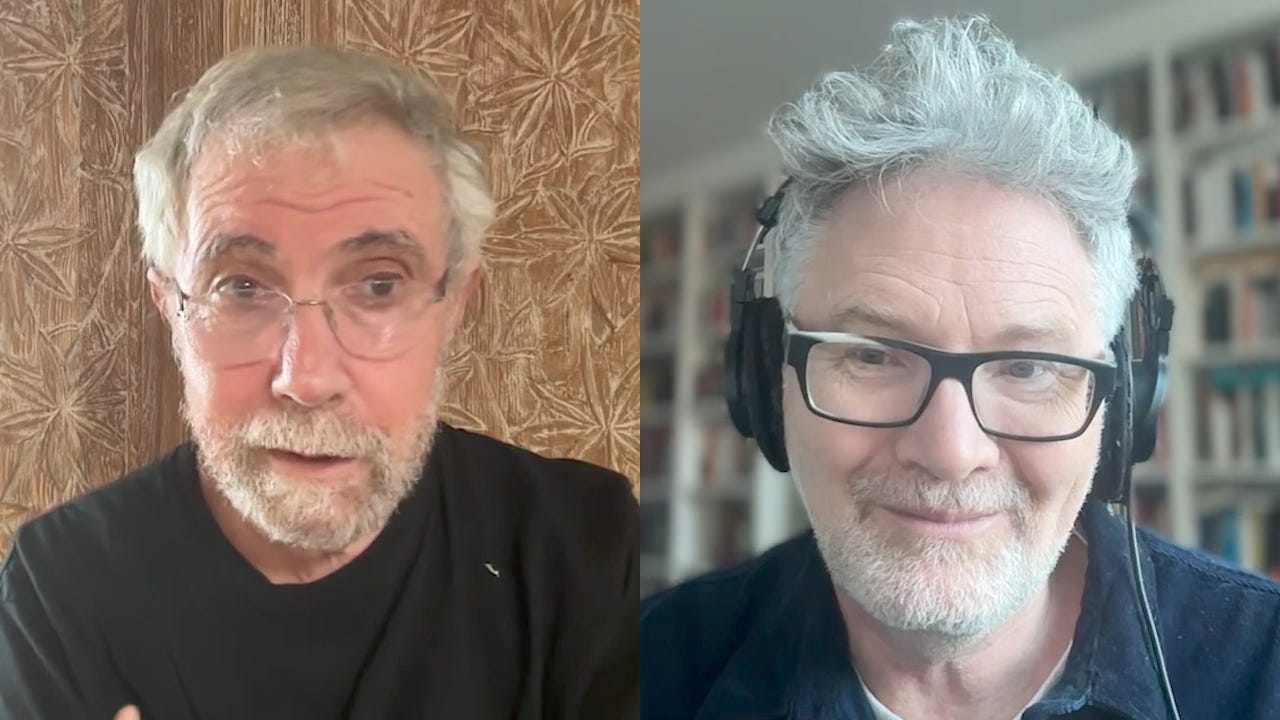
Adam Tooze is a distinguished, prolific historian — I think I was introduced to him by The Wages of Destruction, about the German economy during World War II — who has also been a leader in the newsletter/Substack revolution. His Chartbook is essential reading. Given some of his recent writing about Germany, plus Trump’s declaration that Europe is effectively our enemy, I thought it would be interesting to talk. Transcript follows.
. . .
TRANSCRIPT:
Paul Krugman in Conversation with Adam Tooze
(recorded 12/11/25)
Paul Krugman: Hi, everyone. Paul Krugman here again, enlarging my universe. I’m going to talk today with Adam Tooze, who’s a historian at Columbia. He has a very unique, very influential—I think it was even pre-Substack—but is now on Substack, Chartbook, which has a lot of charts, but also just kinda gives you a lot of information about the world. I know that there are people who are absolutely fanatical about it.
But I also wanted to speak with Adam, because I’ve been writing some about Europe and Adam has a complex background—which we can talk about a little bit—but certainly knows Europe and especially Germany far better than I do. So welcome to my virtual studio.
Adam Tooze: Pleasure to be here Paul, really is.
Krugman: So just quickly, you were born in England, right? But mostly grew up in the former West Germany.
Tooze: That’s right. In Heidelberg.
Krugman: Now you’re at Columbia. Which is just up the road from where I would normally be, although I’m currently someplace a little bit more comfortable.
Tooze: You’re looking a little tan, you’re looking as though you’ve had some sun?
Krugman: Yeah.
I probably spend more time on Europe than the vast majority of U.S. based economists. I’m often more upbeat about Europe than most of the Europeans I know, but it’s in the news now. Trump’s national security strategy sort of is: no problems with Russia, middling on China, and then completely lashes out at Europe. As somebody who has a foot on either side of the Atlantic, which must be quite uncomfortable. How did you feel when seeing this stuff?
Tooze: I mean, I’m glad people are paying so much attention because I remember my shock at reading the national security strategy of the first Trump administration and realizing, “hey everyone, focus! This is extraordinary what’s going on here.” Because that was the one that announced great power competition and really the dawn of a new era with China. It had been sotto voce in the background with Obama and bang, here it was out in the open. Whereas this one we were anticipating for months, because there was all the scuttlebutt about what was going on.
The NSS divides the world into three zones. There’s the Western Hemisphere, over which America just incredibly presumptuously declares the new Monroe Doctrine, Trump corollary. It’s kind of crazy. Then, as you say, there are the other “great powers” with whom one deals peer-to-peer in a way. There’s a mano a mano—rather, a sycophantic kind of relationship between the US and China and Russia. Europe I read essentially as internal, in the sense that Europe is the woke America that MAGA hates worst; it is the secret ally, an extension of coastal America, certainly the East Coast. So in a sense, the culture war agenda that the Trump folks are running in the US can be run in Europe. In some ways, the Islamophobia can even be more explicit in relation to Europe than it is at home. Because you could accuse the Europeans of sacrificing their culture, a great replacement theory—essentially, you can carry on, you can send violence to the Munich Security Conference, and he will already announce this agenda earlier in the year. So that’s what we’re seeing in a strange way, Europe isn’t really distinct from the American political space. It’s the same political space. The conflict is therefore, really uninhibited and overtly partisan. Basically they’re asking for European politics to open the gates to the right. The irony as a European—if you’re a left progressive European—is the idea that somehow it’s a bulk of woke progressive liberals opening the door to Muslim migrants; just go look in the Mediterranean on a bad day, there’s dozens of people drowning, with Frontex blocking the way. The whole thing is a MAGA fantasy, but it is projected onto Europe in a really dramatic way. That’s kind of unique, I think, in the MAGA universe.
Krugman: I was just struck by that one line that said, “some NATO countries may become majority non-European.” Which as they wrote, could have meant Islamic, but also means nonwhite. Although last I heard—although it’s a funny case—Turkey is a member of NATO. (laughs)
Tooze: I mean, I think this is a way of talking about majority-minority America, but not; talking instead about it in Europe. The drama is real, right? The drama in Europe is very extraordinary. If I grew up in West Germany in the early 70s, mine was literally the first cohort of foreign kids to be admitted to German schools. Now, in the big urban areas of Germany, more than half the kids in elementary school have migrant backgrounds. So either they themselves are migrants or one of their parents is a migrant.
Anyone who’s been to Central Europe will know that the transformation is absolutely radical. The old imperial metropolises: Paris, Brussels, London, Dutch cities, have always been very cosmopolitan. But Germany is radically transformed. So there’s a real thing there. There’s a real change that’s extraordinarily dramatic. But MAGA is scaremongering in this grotesque way.
Krugman: So they’re projecting.
Let’s just talk about migrants. There’s really a much larger nonwhite European population pretty much throughout Western Europe than there used to be. I don’t know what the numbers are like, but how many?
Tooze: Germany, if you take the two parts: non-Germans, “Auslander” so-called, non-Germans living in Germany are of a population of 83 million, about 12 million. Then German citizens who themselves weren’t born there but have one German parent, 13 million. So 30% roughly of the German population. In the younger cohorts in elementary school, it’s higher. So it’s like peak-US migration experience. These are numbers comparable with pre-1914 US or the big cities in the US now. It’s very diverse and it comes from a wider range of areas than it does in the US. Because here in the US we have huge flocks from mostly South America, in Europe it’s across a wide territory that the migrants come from; and yes, a larger share of them are Muslim.
Krugman: So, there’s a real transformation. It’s true the only German city I’ve spent any time in—which I know is highly unrepresentative—is Berlin, and Berlin is very clearly not a Deutsche Volk city. It’s a melting pot.
Tooze: No, it truly is. Historically, before Turkish growth really got going and urbanization got growing, I think it was the third largest city in Turkey in the late 70s, or fourth maybe, there was Istanbul, Ankara, Izmir, and then Berlin. But now it’s a much wider array. A whole sort of melting block of different Arab migrants. You can wholly function in Berlin now in English. So it’s become a truly cosmopolitan place, but it’s not a big city, there’s only about 3.5 million there. So it’s also quite an intimate feeling.
And yes, the German chancellor, who has a knack for tactlessness or some would say thoughtlessness, launched this dog whistle talk about Stadtbild: “how does the city look?” He would be saying, “we’re fixing the migrant problem, we know there is this issue with how the city looks.” So there is even in the dominant center right party quite aggressive problematization of this change.
Krugman: On how the city looks, I have mixed feelings about the “walking around” test in general, but I do think that it is sometimes useful to just get a sense of cities and of cultures, though I’m not going to do a Tom Friedman and talk to a wise cabdriver who somehow sounds exactly like me. (laughs)
But, I’ve been going to Berlin for quite a while. It’s a complicated connection, but I have been spending time at the Freie University on and off over the years, and it has changed, even in that time. It definitely feels much less German than it did in the early 1990s. Also last time I was there it felt a little shabby, I don’t know why...
Tooze: Germany has federal organization, Berlin is a state. The notorious debt brake politics in Germany, the non-discretionary fiscal rules are in large part about constraining debt burdens of debt prone local government, and Berlin will be in the crosshairs of that; other deindustrializing cities like Bremen would be in that kind of zone.
So Berlin has issues with funding basic public services at the local level, and you feel that on the street. It isn’t New York on a bad day—let alone other American cities on a bad day—but it is no longer a spick and span European city, it’s not like a Zurich or somewhere like that. So you feel it, it has a rough edge. The hard drug market in certain parts of Berlin is extraordinarily open, much more so than you would see in New York. There’s a withdrawal of policing that alarms people, but the levels of violent criminality are lower than the levels in the US, which themselves are easily exaggerated. So it’s on that level, a very safe place.
The basic infrastructure of public services like transport are way better than in any comparable American city. So I always say to the Germans, “it’s like misery at a high level.” It’s not glossy. Berlin perhaps was never really glossy. What Berlin lacks is real wealth. Germany’s economic geography is interesting because once upon a time, pre-1945, the new capital of Germany after 1871 attracted all of the corporate headquarters, Deutsche Bank, Siemens. Everyone was there, not the Ruhr, the big old steel money, but all of the new money was there. Then after World War two, as it became in Ireland in the Cold War, all of the big money went elsewhere to Frankfurt, to Munich, to Hamburg, and it hasn’t come back with reunification. So it’s a really unusual capital city because until about five years ago it lowered average GDP per capita by including it. Paris and London are a large part of the UK and the French economy. Berlin was a net drag on German GDP; not any longer, but that’s a recent development.
Krugman: Completely off topic. But Zipf’s law; on city sizes for the United States, if you rank our metropolitan areas, the population is inversely proportional to the rank. LA is about half the size of greater New York. Chicago is about a third the size. It’s a shockingly exact relationship, and it’s held true for more than a century. Germany doesn’t look like that at all. There’s no real dominant cities.
Tooze: Germany’s economic geography always was diverse and it’s one of the charms of the country and you mentioned earlier on the volk idea, that’s kind of projection always, they have to imagine themselves a unified, homogenous nation, whereas in fact, both in terms of ethnicity, culture, migration, and religion of course, with the Catholic Protestant divide, it’s a very diverse place.
Only I think one time maybe in modern political history has a party achieved 50% of the vote? The Nazis never came close, 37% in a free and fair election. Konrad Adenauer, Christian democratic boom time West Germany with the East lopped off, all the communists gone: they got to 51%. I think in the early ‘50 election, that’s the only time it’s ever happened. So the society is constitutively diverse, plural and regionalized, highly regionalized. It’s not like a London or a Paris kind of situation.
Krugman: So, let’s talk economics, Europe is still—certainly the EU plus the UK as an economic power—is not that much smaller than the United States.
Tooze: Exactly, people always forget this.
Krugman: There was this big report last year by Mario Draghi, former Prime Minister of Italy. Although I love Ben Bernanke, Draghi I think is history’s greatest central banker, he saved the Euro.
Tooze: Yup no question, most consequential.
Krugman: This report is quite bleak about how Europe is falling behind.
I’m a little bit of a contrarian here—but I’m not sure that I believe in my own contrarianism. But regarding the “walking around” test, I spent a fair bit of time in the Netherlands walking around Rotterdam, Leiden. You can’t walk around Amsterdam because there are too many damn tourists, but walking around the Netherlands does not feel backward, does not feel like it’s lagging. But last time I was in Berlin, it kind of did, now again Berlin is kind of unrepresentative, but you just wrote a really long, quite pretty grim piece about the state of the German economy and political scene.
Do you feel that Europe is really doing as badly as the Draghi report suggested?
Tooze: I think we have to distinguish levels, growth rates, long run trends. The levels argument with Europe is, I think, overwhelming. If you’re faced with a Rawlsian veil-of-ignorance and “you don’t know which passport you’re going to end up with,” you just pray it’s the Dutch one, some high performing country. You could also say history ended there and, “it ain’t broke so why fix it?” What higher material standard of living could you aspire to than a comfortable position in the Netherlands? It is on the other hand—it’s the size of New York, and it has the GDP roughly of the same size as New York State. So it’s a small part of a much bigger picture, which is more diverse and more uneven. But I mean, I think the levels point is very well taken. Same even for Italy, which is generally seen as one of the real laggards. But it’s not for nothing that people go on holiday there. It’s a very, very attractive way of life. I think there’s a lot of under measurement of quality of life aspects in those numbers.
The growth rate is the thing that’s been really worrying for Germany. So Germany’s economy has essentially had a lost decade. We’ve kind of gotten used to that with the UK, Italy, but for Germany to stall out the way it has—again, we’re not talking about any real fall, but to see no growth essentially, in real terms: in per capita income and investment levels in a unit the size of Germany, which is so crucial to Europe as a whole—is very unusual and sets the alarm bells ringing. If you then look at the stuff that Draghi was looking at, which was very informed by the new theories of innovation, the Nobel Prize winners that were looking at Schumpeterian logics of, “are you investing in the right sectors that’ll generate the creative destruction that will generate the long run innovation” and you look at where the R&D is concentrated in Europe, what R&D does happen in the private sector, which is lower than either China or the US, where it happens is in what people now call “mid tech.” So 10, 15, 20 years ago, investment was heavily concentrated in R&D in the German automotive sector, and last year it was still heavily concentrated in the German automotive sector, which is now being overtaken by the Chinese EV manufacturers. I think it’s like this strange combination of a Wile E. Coyote kind of moment with regard to standard of living. It’s like, “oh my God.” Like we’re kind of suspended in mid-air as everything is just fine. To the German question about, where’s the growth gone?
To the third layer of question, which is where is it going to come from in future? And how do we feel about placing third in a heavy hitters battle of oligopolies, state capitalist models we’re seeing in the US and China? That’s where I think the anxiety comes from.
Krugman: Europe has really been largely shut out of tech—which is not actually right, there are other kinds of platform economies.
Tooze: Platform economies, the platforms they are totally out.
Krugman: That’s for real, that’s clear there. Stock market valuations and so on. You need to read a little ways into it, but all of the measured productivity differences between Europe and the United States are really tech, and other stuff looks the same. Which raises questions about how well do we even measure productivity in tech? So, are those numbers for real? But, Germany clearly is kind of stuck in the past, right?
Tooze: No, it’s really extraordinary. If you look at the leading German companies, they’re 100 years old. Once upon a time, 120 years old, 150 years old in some cases, we would have once celebrated that; an America not so long ago also did, a GE, a GM, a Ford, AT&T: these were the bastions of the mid 20th century economy. Germany has kind of remained stuck there, really. For a while, of course, this was reinforced by the needs of the Chinese market, because Germany’s strengths in mid-sized mechanical engineering firms and the people that supply the machines that make the machines really suited the Chinese industrialization model to a T. And so Germany had 20 years in which it was actually kind of running export surpluses with China, which takes something. That flipped on them really badly in the last five years.
Krugman: One of the things that everyone talks about now for Germany is deindustrialization, which is kind of wild. It really says that the Trumpian theory of deindustrialization has to be wrong, because Germany still runs large trade surpluses.
Tooze: Exactly. When we say deindustrialization for Germany, we’re only talking convergence to the norm of a UK, France and Italy, a US. Germany has an outsized manufacturing share, even when everyone was industrialized, it did. It was in that Japan-Belgium league of super high industrialized countries, and it has retained that edge. This was one of the benefits of this 20 year period where they really benefited from globalization and deindustrialization in their case means convergence. They’ve lost their surplus with China. So there’s a hint of Trump kind of logic there, or China shock kind of logic, shall we say.
Krugman: But they’re running off surplus with somebody.
Tooze: Yeah. Overall they’re still running a large surplus with almost everyone else.
Krugman: It’s funny, the oddities: it turns out that, looking at bilateral US European trade, you get very confused because some of it is clearly all wrong. The US normally runs a surplus with the Netherlands.
Tooze: Well this is the Brad Setser kind of logic: “there’s stuff going on in the accounting of American corporations.”
Krugman: Some of it is. The leprechaun economics. One of my contributions with Ireland. (laughs)
But no, a lot of it’s just Rotterdam, a lot of U.S exports to Europe are going to Rotterdam and then being transferred into Germany. The thing is, around 15 years ago, Germany was feeling pretty good about itself. They were feeling quite arrogant about their economic performance, right? At the time of the European debt crisis, obviously Germany was lecturing everybody else on how “we are responsible, we know how to do things.” But you see it in the numbers too, right?
Tooze: They did. The thing we haven’t mentioned so far, it’s kind of extraordinary we’ve gotten this far without mentioning it, is the debt brake. So in the 90s you have the reunification boom, which involves about $1 trillion euros worth of spending, which generates a boom, also a bust. Then you get this combination of labor market, Social Security, people call them “reforms”, I prefer to call them a shock or a change because they actually create the low wage labor market. But then there’s considerable boost from export surpluses, and the extension of the German supply chain into Central Europe, where the high tech German manufacturers are building out, and all of that sustains their growth through the 2000s, and they emerge in a relatively strong position during the European crisis. In 2009, they adopted this policy of basically zeroing out deficits at the state level and very tight constriction of federal deficits and that takes a while to work its way through the system. But from the mid 2010s onwards, they’re beginning to run surpluses. But the cost of that of course, is the erosion of public investment.
They moved to a net negative public investment regime, which is terrible in the long run.
Krugman: So, net negative in this case means that their stuff is depreciating. Public sector stuff. German railroads are shockingly bad, right?
Tooze: Absolutely, yeah. There’s all these stories about how everybody else in Europe’s reliability and punctuality statistics are dragged down by the fact that trains pass through Germany, where they invariably pick up delays. It’s in complete shambles, and it’s an interesting effect of chronic underinvestment. It really isn’t rocket science. It just matters more to Germany because compared to the US, where passenger transport never really was the priority of the system. It was always really freight. In Germany, the passenger transport sector is really a crucial part of the public infrastructure. But education as well, I mean, the school system is dilapidated. The road network is dilapidated. All of this talk now about national security, you can’t actually move heavy military equipment across Germany safely because the bridges aren’t robust enough anymore.
Krugman: Good God.
Tooze: So it’s really it’s pretty it’s pretty astounding. According to the data, America’s public investment is higher, which living in the northeast, it’s a little hard to believe, but that’s what the data show.
Krugman: Again, in Berlin the public transit is really fantastic by US standards. Although New York, it’s ugly and has rats but it’s actually very fast.
Tooze: I know it is, and it’s cheap. New York is, I agree, I was thinking more of the whole corridor.
Krugman: The rest of the rest of America, it’s all cars. The thing that also shocked me is, I’ve basically spent time everywhere but in Germany in Europe and in Italy, it’s always a real shock. The Italian trains are now terrific. Meloni has made the trains run on time, which Mussolini never did, but she kind of has.
Tooze: Yeah. I mean, it’s a modular technology, right? You should be able to just roll it out. As long as you spend properly. The Spanish network is extremely good as well. No, I like your contrarian impulse. Whenever I’m in China a fair amount recently and I’m always trying to get them to take Europe seriously because there is a kind of tendency to dismiss it, to project the collapse of the euro and the EU into the future. That is where Draghi, as you were saying, is just this pivotal figure. This is after all, the significance of the 2012 whatever-it-takes moment is he’s looking skeptical, Euroskeptic, British hedge funds in the City of London in the eyes and saying, “look, we are for real. Do not bet against this. I will make you pay if you bet against it.” There is a kind of a real power to that which is easy to underestimate.
Krugman: By the way, viewers may not know the story. There was this huge crisis of interest rates, Spanish, Portuguese, Italian debts were skyrocketing. Everyone is saying they’re going to go bankrupt. The euro is going to collapse. Paul DeGraue, Belgian economist said, “this is a panic, the numbers don’t really justify this.” Mario Draghi actually agreed and said three words, “whatever it takes,” that the ECB will stand behind that and will make sure the countries don’t run out of cash. The crisis just evaporated like nothing. Most effective central bank statement in the history of humanity, I’m sure.
But now he’s sounding the alarm, and I’m not sure that everyone knows about the Rawls test, but if you had to choose a society to be born into not knowing who in that society you would clearly pick the Netherlands if you had a choice of countries and you probably pick Western Europe over the United States, because to be rich in America is to be really rich, but to be poor is to be really poor. That’s less true in Europe, even in Germany.
Tooze: Yes. No, absolutely. Interestingly, pretax inequality in many of the European countries, because they were exposed to globalization shocks too, that increased very dramatically over the last generation. But the difference is their welfare states, the American welfare state is progressive, it’s just not big enough. Whereas they are both progressive and large welfare states and their tax systems also bite more on the income side.
So the combination means that the post tax, post benefit Ginis in Europe—this is the measure of inequality—it’s just dramatically different. It affects every area of society. It is this constant dilemma of: on one level, this is a uniquely successful social experiment of an egalitarian, relatively egalitarian kind, but how do you guarantee its future? And one of the more alarming things I think about the Draghi report is his prescription, which was basically to say “we need more state capitalism.”
There’s lots of different ways of putting this. Some of them are more polite, some of them are more critical sounding. But essentially we need more productivity growth and profit enhancing collaboration between governments in Europe and the private sector, because that is the formula that we have seen work both in the US and China to generate, as you were saying, these outsized performance gains, notably in the tech sector. It’s not a story just of markets or businesses. It’s not a story just of government. It’s a story of the two collaborating. Essentially he’s saying, “the Europeans have been overzealous when it comes to anti-competition regulation, and they should be tolerating higher oligopolistic profits that will be turned back, we hope, into investment and therefore productivity growth.” That I took to be the message of Draghi. He may very well be the most consequential central banker. You could also read him as the most articulate mouthpiece of European capital, of European business and in the grand sense of architecting strategy for European business. He is the person who articulates that.
Krugman: So he’s basically calling for what the French used to call national champions, except that they’re continental champions.
Tooze: He’s very French. The whole thing. This is one of the debates that is going on. We’ve been talking a lot about Germany. The headlines have been grabbed by political turmoil in France, worries about the bond market. But in one way, you could definitely say that the debate in Europe, in policy terms, has been sliding in the French direction because a way of reading Europe over the last 25 years is they drank the neoliberal Kool-Aid. They really actually took a whole variety of things very seriously. Highly independent central bank, non-discretionary fiscal policy, no picking winners on industrial policy, and really rather effective policing of competition in the interests of consumers barring various types of industrial merger. So not the American sloppy, loosey goosey kind of market monetarist deal, but something much more hard nosed. Essentially Draghi is saying, “maybe we played too much by the rules. Maybe we took all of this far too literally. Maybe actually what was going on was another kind of model.” We need to be realistic about it. The people who have preached that consistently have been the French.
Krugman: Now, it’s interesting. I actually have done zero homework on France. How is France doing?
Tooze: There’re two dimensions to this, the bond market is the thing that gets the headlines. What’s happened is that, during the crisis we were referring to, 15 years ago France joined Germany in the high quality debt club, in part because the Germans weren’t issuing any debt. And if you’re a bond trader, you love debt because you’ve got to actually have something to transact.
So French government debt served as a near substitute for the non-existent German debt. And so OATs, so called, these are with the French government that were very popular. Their price went up, their yield went down. And what’s happened in the last 4 or 5 years is that France has slid back towards the Spain-Italy camp, and that’s come as a huge shock to Paris because its debt level is almost American. It’s not quite American, but it’s almost American. If you’re France and in the eurozone system and you don’t control your own central bank the way that the US potentially does, this is worrying. Not from a macro point of view, there’s no reason to panic. It’s really worrying because the politics of France is deadlocked and the Macron effort to stabilize a centrist, pro-market, liberal policy has failed.
So really, the question is whether or not Marine Le Pen’s far right party doesn’t break through at the next presidential election, because to stop it now would take a coalition of centrist and leftist forces. It’s not clear anyone’s in a position to articulate that. So it’s kind of like a bond market situation that’s a little bit iffy, but not really in any way critical combined with genuine uncertainty about the functioning of French democracy.
Krugman: Germany has low debt. But it also has dreadful demography, right?
Tooze: Yes. Dreadful demography in terms of that, because the bargain for women of childbearing age is really shitty.
Krugman: Yeah.
Tooze: The labor market conditions are not what they should be, and childcare is catching up, but it’s not as good as it should be. So a lot of women have opted out of that kind of bargain. So what you do see is an awful lot of part time working. If more women were employed at full time rates more and more, according to European averages, then the labor market issues would rather disappear.
Yes, there is bad demography in Germany. There’s plenty of people who’d happily be part of the German labor force. It’s just a question of whether German society can absorb that.
Krugman: That’s right. The issue: fertility is well below replacement and the population will shrink. I guess the last projections I saw said not that France is awash in babies, but that still at a certain point, sometime in and a few decades from now, Napoleon wins and France has a larger population than Germany.
Tooze: I just think that’s a matter of migration trends.
Krugman: So we have these European societies and Germany is certainly it’s kind of less cushy, less comprehensive social safety net, but still beyond the wildest dreams of the American left. France, even more so. The economies are not poor. On the whole, it’s sort of everything for a center left American that would be beyond anything that you could reasonably hope to enact. Yet you have the hard right definitely gaining strength. Germany, the AfD, I don’t know if they’re actually worse, really, than Le Pen’s people, probably, but you do have a party that is pretty obviously neo Nazi that is really gaining strength. So what’s going on? What feeds all of this discontent?
Tooze: Well, I mean, I would say the analogy is—let’s just start in the U.S. I mean, let’s start with the GOP that we’re familiar with, right? There’s a neo-Nazi wing, an outright fascist wing, Hitler saluting, the whole works. They aren’t, I would say, the majority of any of the far right parties. All of these parties are not to the right of the GOP. It’s important to emphasize that they just happen to be in Europe, like the AfD is by no means more right wing than Trump’s GOP. They are just German, which is worrying.
Krugman: That’s interesting.
Tooze: The opinion polling on Germany suggests there’s about 1 to 2% of the population which are actually Nazi. Then you have a 5 to 10% who are hardcore, authoritarian, post democratic. Then you have a—currently they’re polling in the mid 20s, they’ve never gone higher than that—who are willing to contemplate voting for a party that wants systemic change, all the MAGA stuff like total change and all that. It’s what’s very familiar and it’s well short of the numbers that the GOP gets. Because there is an alternative, which is that you can vote for a centrist right wing party, which is where the sensible Republicans would be if they had the option. And it wasn’t the first past the post system, which is the CDU, which is Chancellor Merz’s party which is conservative, skeptical towards migration but not actually racist, and doesn’t have a neo-Nazi base.
So that is the configuration. It’s typical of France as well, and it used to be typical of Italy. Why are these parties gaining the support they are? It’s a familiar mix of motives, the cocktail is composed slightly differently. The really big difference is that anti-black racism plays a much smaller role in Europe, and Islamophobia is much more important. So the core of the xenophobic, racist element is Islamophobia. The anti-black element is strictly secondary everywhere, I think including in France, where they overlap incredibly closely because the black migrants tend to be from North Africa. So you get all from the Sahel, so you get a very close overlap. But in Germany, it’s really Islamophobia that’s doing the driving.
So that’s a distinction to the US. Because of this radical change in the composition of the population, especially since 2015 with the Syrian crisis and the refugee crisis and ISIS and all of that, there was that kind of impulse. The other element is an anti elite affect, which is powerful across all of European societies. They are, like us, very unequal places. It’s more discreet than in the US. The average levels of inequality are slightly lower. But, you know, anyone in their right mind can see that all of these European societies are profoundly unequal. And furthermore, in the media, in education, in the professions, there is, as in the US, a strong liberal bias across the board. So it’s very easy to mobilize a populist anti PMC, anti professional managerial class kind of coalition in most of these societies as well.
Then you’ve kind of got the growth story like substantial minorities of the European population are kind of wondering like where they’re promised—it’s not the American dream type thing, but nevertheless—where the promise of affluence and stability that was once theirs, where that’s coming from and where the well-paid, secure, meaningful blue collar jobs are that their dads or granddads used to have, like where that’s coming from and why some Turkish or Arab or Syrian guy has got that and they haven’t. Why is there a huge queue at the hospital and why there’s no spaces for kids at school and why, if your nephew goes to school, he goes to a class which is 60% migrant? They’re asking themselves those kinds of questions. If you add all of that up, you get to this kind of voter potential.
Krugman: There’s a left-behind-regions issue as well. Right?
Tooze: Oh absolutely huge inequality.
Krugman: So the DRR is never…
Tooze: Well depends where you look. I mean, if you go to Leipzig or Dresden, you’d have that same reaction of, “oh my God, if there was a single city in a United States like this, it would be headline news.” But if you go out to the countryside, the back areas of East Germany, I’d hesitate to say that they’re not West Virginia, but they are pretty grim places with few prospects. Large outmigration of young people. So you get residual components. The polarities are very extreme. They are, in fact, most extreme in the UK, which we’re not talking about because it’s not in the EU story, but they are nevertheless very stark. The former industrial areas of northern Europe, northern France, Belgium, are grim.
Krugman: There’s the obliviousness of people of our class occasionally. I was talking a few years back, but, with a very eminent, very smart, British former public official, etc. and he said “well, of course, in England, we don’t have places these blasted left behind regions the way you have the United States.” And I was saying, “have you been to Yorkshire lately.” (laughs)
Tooze: No, seriously.
So then you ask yourself why somebody in one of those regions might be absolutely furious about the assholes in London. Like, they don’t get it right. They don’t. They fundamentally don’t understand, so, that’s the cocktail.
My sense is that it’s more visible in Europe because they generally have PR proportional representation type systems. So they have about six parties in the same way as the US has six parties, it’s just three of them are grouped into each of the two main parties in the US. So they’re not visible. But you know, if you think about the Democratic Party coalition as was Manchin through to AOC and you think of the similar kind: McCain through the far right of MAGA, essentially the spectrum is very similar in Europe. It’s more fragmented, it’s more visible in most countries.
There’s another thing, there’s countervailing tendencies. The Dutch, which both of us agree it’s an amazing society, but they voted for a far right government. They got a far right government, it was a total shambles, so they voted for moderates. In Italy, the Fratelli d’Italia, who really were once upon a time a post fascist party. Post, as in: “We used to be fascist, we’re not fascist anymore,” not like, “goodbye to fascism.” Meloni really was a street activist of a fascist party. Yet in office, she turns into something that’s more recognizable as a mainline conservative, to be honest, with a hard nationalist edge in a hard culture world politics. But she’s not taking Italy back to fascism. That’s not what’s happening. So Germany is a really fascinating case because it’s a little bit like exchange controls, or something like that. They’ve put what they call a firewall, which is that no one will talk to the AfD. The problem is what happens when you kind of have to actually make democracy functional? What is the consequence for democracy of just refusing to talk to them at all? So they’re trying an exclusion strategy, they even actually talked about criminalizing the AfD, because the Germans have what they call “a democracy that defends itself.” So if they’re agencies of constitutional protection judge that the party is anti-constitutional, they can outlaw the party. They came pretty close to doing this for a party that represents 25% of the population.
So that’s different in Italy, what we’re seeing is transformismo, this strategy: you bring them in and then see what happens, and they end up being digested by the logics of Italian society; in Germany right now they’re holding the AfD at bay. The anxiety of those opinion polls is that they do it every Sunday in Germany and the question is essentially, how do the other parties form viable coalitions if they’re not going to talk to the 25%?
Krugman: So the United States may have it worse just because we probably have about the same number of people with hard right inclinations as everybody else. But because of our primary system and two party system, that faction ends up controlling.
Tooze: Exactly, the tail ends up wagging the dog. It’s like the most radical wing ends up dictating politics. And then there’s the gerrymandering. And so they’re quite insulated. We haven’t yet in Western Europe seen that subversion of institutions. Italy, maybe a different story. But the worry in the US, presumably now, is that the institutions themselves—I was thinking of gerrymandering—the entire process is becoming deeply politicized. We’re not seeing that yet in Germany.
Krugman: Okay. It’s worrisome. The theory behind social democracy is in part that if you take care of people, then they will support the constitutional order and all of that. And it kind of doesn’t work? Is that the European lesson?
Tooze: By itself, it’s not enough. And furthermore, people’s standards constantly adjust. And so people in Europe are not benchmarking themselves against West Virginia and saying, “oh my God, I’m so glad I’m not there.” They’re comparing themselves to memories of the past to nicer parts of their own countries. They’re doing all of that relativity stuff where they see foreign neighbors getting things which they think they should have. So I think the bigger lesson is that this A-rated social democracy, a social democracy without politics, without a public sphere that actually does the political education. And I think the left and progressives have to embrace this, like, does the work of explaining what this is about and what the trade offs are not in the kind of, woke sense, but in the sense of: these are the logic of social democracy, this is how economies work, this is how people fit in, these are the mechanisms that we have to uphold and continue to use creatively. That’s what I think has been lost, not just in the US, because of course it’s been lost in the US as well, but has attenuated in Europe. So it’s more kind of a Putnam story of the erosion of the social institutions that went with social democracy and one shouldn’t, in the European case, either underestimate the extent to which those social democratic compromises—these welfare states—were, after all, built on top of societies which had gone through the full on murderous Civil War period of the first half of the 20th century. Italians on Italians, French on French, Germans on everyone, Pole on Pole—really savage. This was the cauldron of revolution, and it was ultraviolent. Tens of millions of people are killed and are killing. And out of that came these very tightly wrought, powerfully constrained Cold War compromises and a lot of that fabric, the guts, the real undergirding of what made those societies what they were has just eroded and attenuated in the last 30 years.
So what you’re left with is kind of high performing welfare states, but without any of the political guts, the German welfare state still works incredibly well in moderating the difference between pre tax and post tax Gini. Like, does it make Germans feel as though they’re part of a functioning social democracy? No it doesn’t.
Krugman: Okay, so just the last question, and of course you don’t know the answer but can Europe get its act together sufficiently to be the competitive player on the world scene that it ought to be, if only to reflect its values?
Tooze: It’s interesting the response to Ukraine, we haven’t spoken about Ukraine, the thing that really hangs over Europe in a way it doesn’t in the US. People interested in foreign policy follow Ukraine in the US, in Europe it’s like really up close. There are millions of Ukrainians living in Western Europe, especially in Germany. The war is really close by and America is absenting itself, NSS makes that very clear. So Europe is facing a huge challenge. And I think the evidence is they will rise to it. Not sufficiently not the way you would hope, not by way of the EU, essentially large expansion of an EU army. None of that’s going to happen. But are they going to assemble a coalition sufficient to deter Russia? Yes, and that’s quite remarkable. America has not faced a challenge like that, right? A proper war with a real antagonist as close as Ukraine is, this is a real challenge. I think Europe will face it.
Europe responded to Covid in many ways, I think more effectively than the US in 2020. The vaccine was America’s great gift, the mRNA vaccines, but also in partly with European science expertise feeding in. I think a lot turns on how we think the AI tech story is going to go. If you really think that is the center of all future development, then Europe is in a weak position unless it can position itself in the AI using AI application kind of space. If you think that is likely going to be a bust, then of course America’s future looks darker and we might, in two years time, be having a very different conversation over the wreckage of excessive American stock market valuations and Europe in a much more relatively strong position.
You’re right, I don’t know the answer. But, there’s this cliche about Europe, Jean Monnet saying that, “Europe is the sum total of answers found to crises.” And it’s still in the business of trying to find answers to crises. One of the things I find interesting about Europe, unlike in the US, is there is actual constitutional change; over the period of our lifetimes, since the 70s, there have been really deep constitutional changes in Europe and at lots of different levels. The Germans got their act together to fight the two thirds majority only earlier this year to get rid of their debt brake. Imagine that happening in the US right now. So there’s a kind of fluid, even in this old continent, like there is a fluidity of politics and institutions and an openness to quite deep change that unfortunately, we don’t have in the US.
Krugman: So that’s an upbeat note. And I will say, I agree that relative to what you might have wanted, Europe’s response to Ukraine has fallen short relative to what you might have expected. I mean, it’s actually astonishingly positive.
Tooze: Yeah, I agree.
Krugman: So there remains hope for Europe and God knows we need some place in the world that still believes in democratic values.
Tooze: Yes.
Krugman: Okay. Thanks so much for talking to me.
Tooze: It’s a pleasure. Thanks for having me on.
 reply
reply


